0

Tax Collected at Source (TCS) on Foreign Remittances in India

Rate this post

When an individual sends money abroad, the transaction may attract Tax Collected at Source (TCS), commonly referred to as foreign remittance tax in India.

As per Section 206C(1G) of the Income Tax Act, 1961, banks and other Authorized Dealers (ADs) are required to collect TCS at the prescribed rates at the time of transferring funds overseas under the Liberalized Remittance Scheme (LRS).
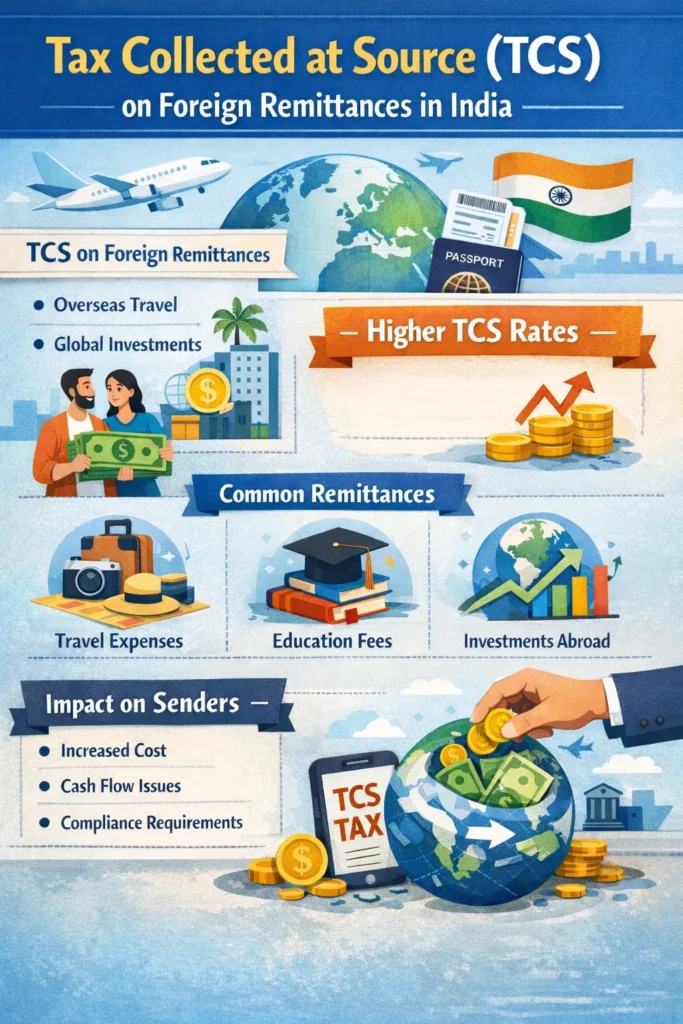
The TCS collected is not an additional tax but is reflected in the taxpayer’s Form 26AS and can be claimed as a credit or refund while filing the Income Tax Return, subject to eligibility.

Budget 2026 – TCS Rationalisation on Foreign Remittances

In the Union Budget 2026–27, the Government of India has proposed significant reductions in the Tax Collected at Source (TCS) applicable to certain overseas remittances under the Liberalised Remittance Scheme (LRS):

Education and Medical Remittances: The TCS rate on remittances for education and medical purposes under the LRS has been reduced from 5% to 2%. This reduction is intended to ease the upfront cash outflow for individuals transferring funds abroad for these essential purposes.

Overseas Tour Programme Packages: The TCS on overseas tour packages has been simplified to a flat 2% with no monetary threshold. Previously, the rate varied (5% up to ₹10 lakh and 20% above ₹10 lakh), but the budget proposes a uniform 2% rate regardless of the package value.
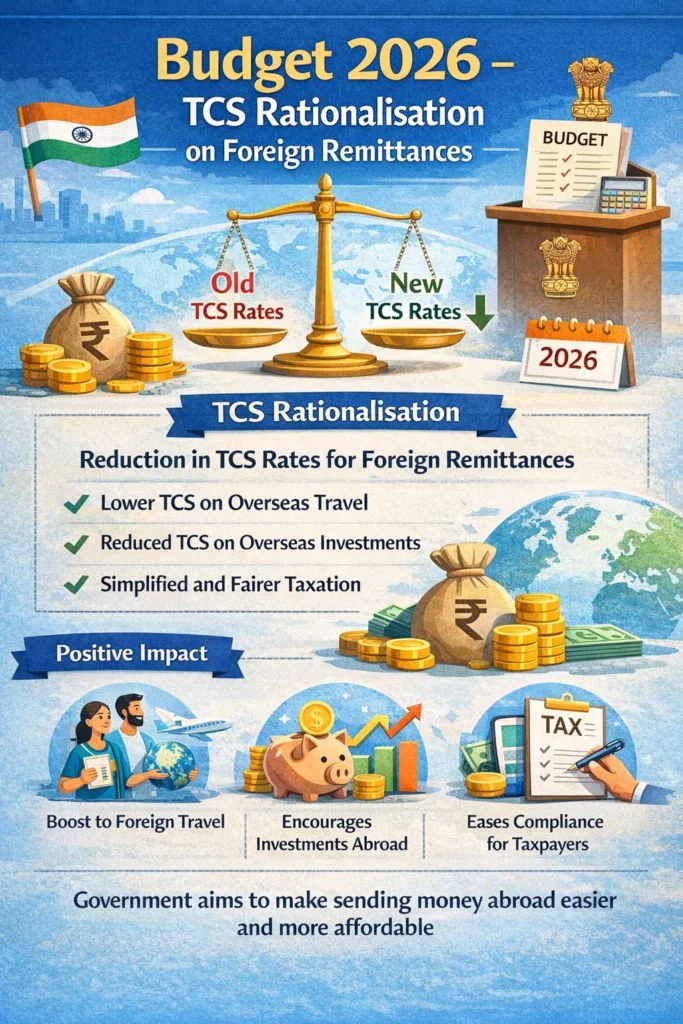
These changes are part of a broader rationalization of TCS provisions and are proposed to take effect from 1 April 2026 upon enactment of the Finance Bill.

What is TCS on Foreign Remittance?

Tax Collected at Source (TCS) on foreign remittance applies when an Indian resident transfers money outside India under the Reserve Bank of India’s Liberalised Remittance Scheme (LRS).

Under this provision, the authorized dealer or bank collects TCS at a prescribed percentage on the amount remitted and deposits it with the Government of India on behalf of the remitter.

Key Points to Note

  • The TCS collected is reflected in Form 26AS of the remitter.
  • The amount of TCS can be adjusted against the final income tax liability while filing the Income Tax Return (ITR).
  • If the taxpayer does not have any tax liability, the deducted TCS can be claimed as a refund.
  • TCS under this provision applies only to outward foreign remittances, i.e., when money is sent outside India.
  • Inward remittances (money received from abroad) are not covered under this provision and do not attract TCS.

Exemptions from Foreign Remittance Tax (TCS)

Certain foreign remittances are exempt from Tax Collected at Source (TCS) under the Liberalised Remittance Scheme (LRS). These exemptions help reduce the tax burden in specific situations.

The following remittances are not subject to TCS:

  • Education Loans:
    Remittances made for education out of loans obtained from banks or notified financial institutions (eligible under Section 80E) are fully exempt from TCS.
  • Lower-Value Remittances for Education and Medical Purposes:
    Remittances up to ₹10 lakh in a financial year for education or medical treatment are not liable to TCS.
  • International Credit Card Payments:
    Payments made using international credit cards while overseas are currently kept outside the scope of TCS until further notification by the government.

Note:
These exemptions apply only to eligible outward remittances made by Indian residents under the LRS. Any remittance not covered under the above categories may still attract TCS at the applicable rates.

Examples to Understand Exemptions from TCS on Foreign Remittance

Example 1: Education Loan (Fully Exempt)

Riya takes an education loan from a bank to study in the UK.
Her bank remits ₹15 lakh directly to the foreign university.

  • TCS applicable? No
  • Since the remittance is funded through an education loan under Section 80E, it is fully exempt from TCS, irrespective of the amount.

Example 2: Education Remittance Below ₹10 Lakh

Amit sends ₹8 lakh from his savings to pay his daughter’s college fees in Australia.

  • TCS applicable? No
  • Remittances for education purposes up to ₹10 lakh in a financial year are not subject to TCS.

Example 3: Medical Treatment Below ₹10 Lakh

Neha remits ₹6 lakh to a hospital in Germany for her father’s medical treatment.

  • TCS applicable? No
  • Since the amount is below ₹10 lakh and for medical purposes, no TCS is collected.

Example 4: International Credit Card Usage Abroad

Rahul travels to Europe and spends ₹3 lakh using his international credit card on hotels, food, and shopping.

  • TCS applicable? No (currently)
  • International credit card payments made while overseas are temporarily excluded from TCS, as per current government clarification.

## TCS on foreign remittance does not apply in genuine education and medical cases (within limits) and on bank-funded education loans. Even where TCS is collected, it is adjustable or refundable while filing your income tax return.

Who Is Required to Collect TCS on Foreign Remittance?

Under Section 206C(1G) of the Income Tax Act, 1961, the responsibility to collect Tax Collected at Source (TCS) on foreign remittances lies with the Authorised Dealer (AD) facilitating the transaction.

Specifically, TCS must be collected by:
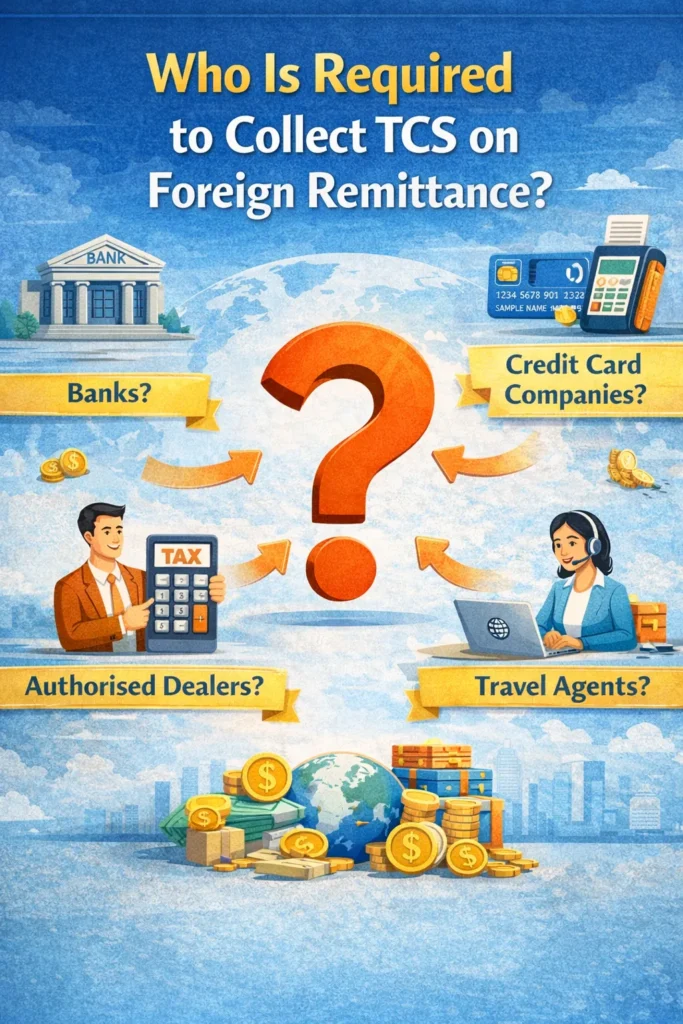
  • Banks authorised by the Reserve Bank of India to deal in foreign exchange
  • Authorized Dealers/Money Changers approved by RBI
  • Overseas tour operators (in case of overseas tour programme packages)

Key Clarifications

  • The TCS is collected at the time of remittance or at the time of receipt of amount from the remitter, whichever is earlier.
  • The remitter (individual sending money abroad) does not deposit TCS directly; it is collected and deposited by the authorised dealer.
  • The collected TCS is reported against the PAN of the remitter and reflected in Form 26AS / AIS.

In Simple Terms

If you are sending money abroad, your bank or authorized forex dealer will automatically collect the applicable TCS and deposit it with the government on your behalf.

How to Check and Claim TCS on Foreign Remittance

When you send money abroad under the Liberalised Remittance Scheme (LRS), banks or authorised dealers may collect Tax Collected at Source (TCS) on the transaction. This TCS is not a final tax but a credit available to the remitter. To ensure you receive the benefit of the TCS collected, it is important to verify that the amount has been correctly reported and to claim it while filing your Income Tax Return. The following steps explain how you can easily check and claim TCS on foreign remittances.

Step 1: Check TCS Credit in Form 26AS

After remitting money abroad, the bank or authorized dealer collects TCS and deposits it with the government.
You can verify this TCS credit by:

  • Logging in to the Income Tax e-Filing Portal
  • Navigating to e-File → Income Tax Returns → View Form 26AS
  • Checking Part F – Details of Tax Collected at Source (TCS)

The TCS amount collected on your foreign remittance will be reflected here.

Step 2: Verify in Annual Information Statement (AIS)

You can also cross-check the TCS details in your Annual Information Statement (AIS) available on the income tax portal.
This helps ensure that the remittance and TCS details reported by the bank are accurate.

Step 3: Claim TCS While Filing Your ITR

While filing your Income Tax Return (ITR):

  • Declare your total income
  • The TCS amount appearing in Form 26AS/AIS is auto-populated
  • This TCS is adjusted against your final tax liability

Step 4: Adjustment or Refund

  • If your tax liability is higher than the TCS amount, TCS gets adjusted, and you pay the balance tax.
  • If your tax liability is lower than the TCS amount, the excess TCS is refunded to your bank account.
  • If you have no tax liability at all, the entire TCS amount is refunded after ITR processing.

Important Points to Remember

  • TCS on foreign remittance is not an additional tax but only a tax credit mechanism.
  • Claiming TCS is possible only after filing your ITR.
  • Always ensure your PAN is linked with the bank remitting funds to avoid higher TCS rates.

How to Transfer Money to the USA

Indian residents can transfer money to the USA under the RBI’s Liberalised Remittance Scheme (LRS), subject to prescribed limits and compliance requirements.

Step 1: Choose the Mode of Transfer

You can send money to the USA using any of the following methods:

  • Bank Wire Transfer (SWIFT):
    Direct transfer through Indian banks (SBI, HDFC, ICICI, Axis, etc.). Suitable for large or formal transactions.
  • Online Money Transfer Platforms:
    RBI-authorised platforms like Wise, Western Union, or bank-linked fintech services. Faster and often cost-effective.
  • Foreign Currency Accounts:
    Transfers from RFC or FCNR accounts, if available.

Step 2: Ensure Eligibility Under LRS

  • The remitter must be an Indian resident.
  • The total remittance should be within USD 250,000 per financial year under LRS.
  • The purpose of remittance must be permitted (education, medical expenses, investments, maintenance of relatives, etc.).

Step 3: Provide Required Details

You will need to submit the following:

  • PAN card of the remitter
  • Beneficiary details (name, address, bank name, account number)
  • SWIFT/BIC code of the US bank
  • Purpose of remittance
  • Form A2 and LRS declaration (usually online)

Step 4: TCS on Foreign Remittance (If Applicable)

  • Banks may collect Tax Collected at Source (TCS) under Section 206C(1G).
  • The TCS amount is reflected in Form 26AS and can be adjusted or refunded while filing the Income Tax Return.
  • Certain remittances (education loans, medical/education up to limits, etc.) may be exempt from TCS.

Step 5: Confirm and Track the Transfer

  • Once submitted, the bank processes the request.
  • You will receive a SWIFT confirmation or transaction reference number.
  • Funds usually reach the US account within 1–3 working days, depending on the mode chosen.

Key Things to Keep in Mind

  • Exchange rates and bank charges vary—compare before transferring.
  • Ensure correct beneficiary details to avoid delays.
  • Always use RBI-authorised channels to remain compliant.

Consequences on Failure to Comply with TCS on Foreign Remittance

Failure to comply with the provisions relating to Tax Collected at Source (TCS) on foreign remittances can lead to financial and legal consequences, particularly for banks and authorized dealers, and in some cases for the remitter.

FAQs on TCS on Foreign Remittance (India)

1. What is TCS on foreign remittance?

TCS (Tax Collected at Source) on foreign remittance is a tax collected by banks or authorised dealers when an Indian resident sends money abroad under the Liberalised Remittance Scheme (LRS), as per Section 206C(1G) of the Income Tax Act.


2. Who is responsible for collecting TCS?

TCS is collected by the authorised dealer, such as:

  • RBI-authorised banks
  • Forex dealers
  • Overseas tour operators (for tour packages)

The remitter does not pay TCS directly to the government.


3. Is TCS an additional tax?

No. TCS is not an additional tax. It is only a tax credit that can be:

  • Adjusted against your final income tax liability, or
  • Claimed as a refund while filing your Income Tax Return (ITR).

4. Where can I check the TCS collected?

You can check the TCS amount in:

  • Form 26AS (Part F – TCS details)
  • Annual Information Statement (AIS) on the Income Tax e-filing portal

5. Does TCS apply to all foreign remittances?

No. TCS applies only to outward foreign remittances under LRS.
Inward remittances (money received from abroad) are not subject to TCS.


6. Are there any exemptions from TCS on foreign remittance?

Yes. TCS is not applicable in the following cases:

  • Remittances funded through education loans from banks/financial institutions (Section 80E)
  • Remittances up to ₹10 lakh for education or medical purposes
  • International credit card spending abroad (currently excluded)

7. What happens if PAN is not provided?

If PAN is not furnished:

  • Higher TCS rates may be applied
  • Claiming TCS credit or refund may become difficult

Providing PAN is mandatory for smooth processing.


8. When is TCS collected?

TCS is collected by the authorised dealer:

  • At the time of remittance, or
  • At the time of receipt of funds from the remitter, whichever is earlier.

9. Can I claim a refund of TCS?

Yes. If your final tax liability is lower than the TCS collected, or if you have no tax liability, you can claim a refund while filing your ITR.


10. Does TCS affect the LRS limit?

No. TCS does not reduce the annual LRS limit of USD 250,000. It is calculated over and above the remitted amount.


11. What are the consequences of non-compliance?

Non-compliance can lead to:

  • Interest and penalties for the authorised dealer
  • Delays in remittance
  • Difficulty in claiming credit or refund for the remitter

Leave a Reply

Your email address will not be published. Required fields are marked *