
0

CSR as per Section 135: Applicability, Calculation & Rules

Rate this post

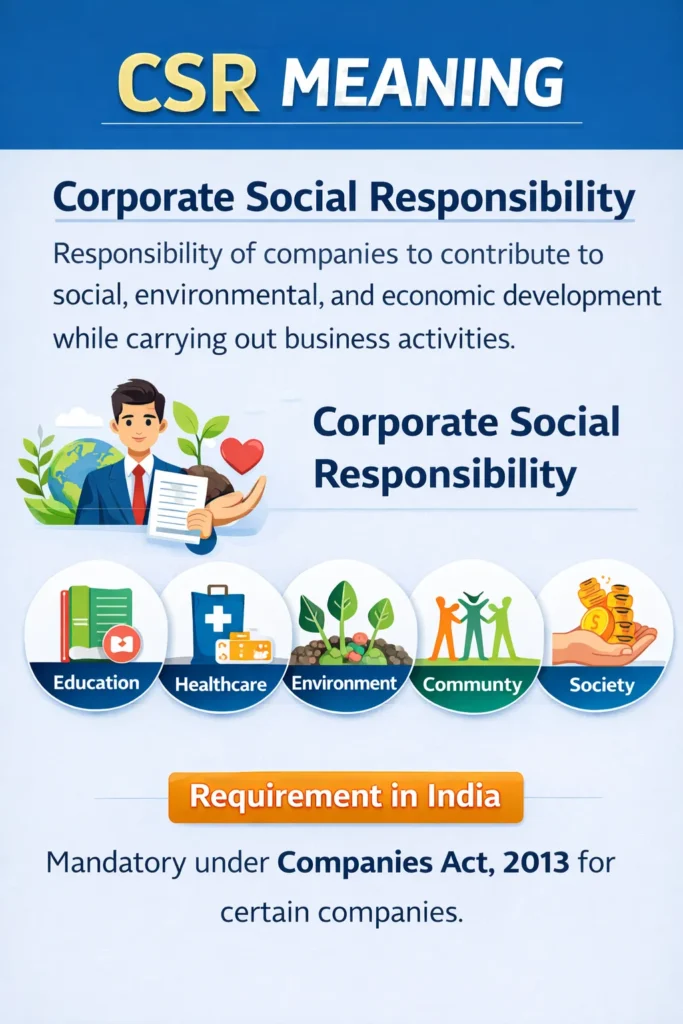
Corporate Social Responsibility (CSR) means the commitment of companies to operate responsibly by contributing to social welfare, environmental protection, and sustainable economic development while conducting their business activities.

In India, CSR is not just a voluntary business practice—it is a statutory requirement for certain companies under the Companies Act, 2013, making it an integral part of corporate governance and ethical business conduct.
What is CSR?

Corporate Social Responsibility means the responsibility of companies to contribute to society by spending a part of their profits on social, environmental, and community development activities—like education, healthcare, poverty alleviation, environmental sustainability, etc.

In India, CSR is mandatory for certain companies under the Companies Act, 2013.

Objective of CSR Reporting

Applicability of CSR (As per Section 135 of Companies Act, 2013)

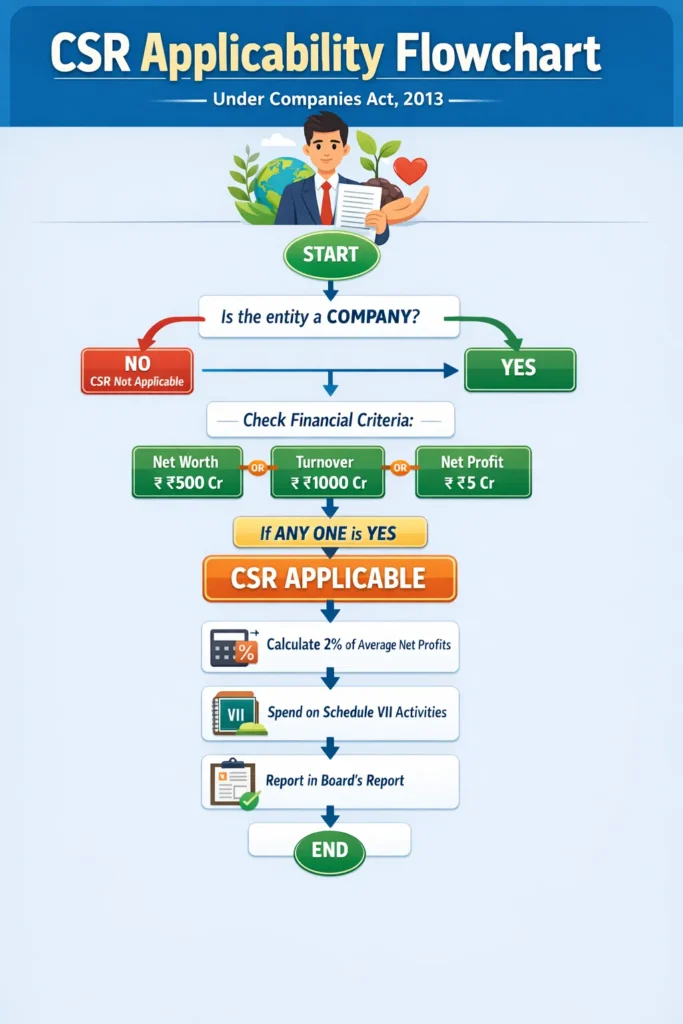
CSR provisions apply to a company if, during any financial year, it meets any one of the following criteria:

CriteriaLimit
Net Worth₹500 crore or more
Turnover₹1,000 crore or more
Net Profit₹5 crore or more

**If any one condition is satisfied, CSR becomes applicable.
Example:

ABC Pvt Ltd has the following details for FY 2024–25:

  • Net Worth: ₹120 crore
  • Turnover: ₹850 crore
  • Net Profit: ₹6 crore

Since net profit is more than ₹5 crore, CSR is applicable, even though the other two limits are not met.

CSR Amount Calculation:

  • Average net profit of last 3 years = ₹5 crore
  • CSR obligation = 2% of ₹5 crore = ₹10 lakh

ABC Pvt Ltd must spend ₹10 lakh on CSR activities.

CSR Spending Requirement

CSR Committee

  • Companies covered under CSR must form a CSR Committee of the Board.
  • However, if the CSR spending obligation is up to ₹50 lakh, forming a CSR Committee is not mandatory (the board itself can handle CSR).

Eligible CSR Activities

CSR activities must fall under Schedule VII, such as:

  • Education & skill development
  • Healthcare & sanitation
  • Environmental sustainability
  • Women’s empowerment
  • Rural development
  • Disaster relief
  • Promotion of sports

# Activities done only for employees or normal business activities are not considered CSR.

Types of Companies Covered

CSR applies to:

  • Private Limited Companies
  • Public Limited Companies
  • Listed Companies
  • Unlisted Companies
  • Foreign companies having a branch/project office in India (if criteria met)

Who is NOT Required for CSR?

CSR does not apply to:

  • Partnership firms
  • LLPs
  • Sole proprietorships
  • Individuals/professionals
  • HUFs
  • Companies not meeting the above limits

Penalty for Non-Compliance (Section 135)

As per Section 135(7) of the Companies Act, 2013 (after the 2021 amendment), criminal punishment was removed and replaced with monetary penalties.

If a company fails to:

  • Spend the CSR amount, and
  • Fails to transfer the unspent amount to the specified funds/CSR account within the prescribed time

Then the penalty is

Person LiablePenalty
CompanyTwice the unspent CSR amount OR ₹1 crore, whichever is less
Officer in Default1/10th of the unspent amount OR ₹2 lakh, whichever is less

Important Point (Very Common Doubt)

Once CSR becomes applicable:

  • The company must comply with CSR provisions
  • Even if it later falls below the limits, CSR continues for next 3 years

CSR Reporting and Disclosure

CSR reporting and disclosure refer to the mandatory reporting of corporate social responsibility activities, expenditure, and compliance by companies to ensure transparency and accountability.
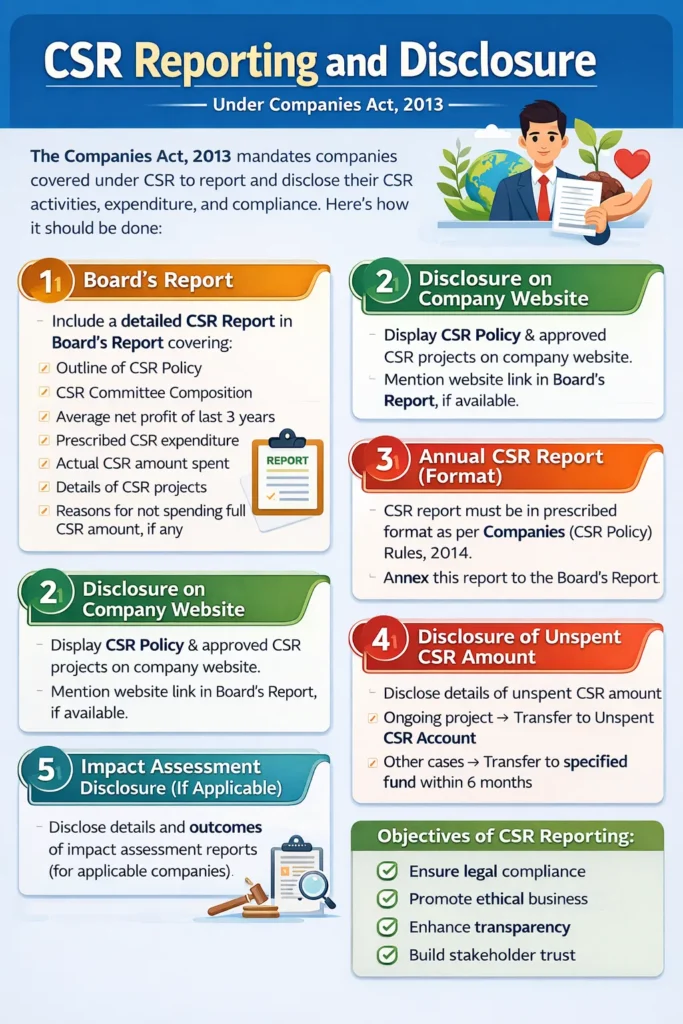
Under the Companies Act, 2013, companies to which CSR is applicable must disclose CSR-related information in the following manner:

Board’s Report

The company must include a detailed CSR Report in its Board’s Report, covering:

  • Brief outline of the CSR Policy
  • Composition of the CSR Committee (if applicable)
  • Average net profit of the last three financial years
  • Prescribed CSR expenditure (2%)
  • Actual CSR amount spent during the year
  • Details of ongoing and completed CSR projects
  • Reasons for not spending the full CSR amount, if any

Disclosure on Company Website

  • The CSR Policy and approved CSR projects must be displayed on the company’s website, if available.
  • The website link must be mentioned in the Board’s Report.

Annual CSR Report (Format)

  • CSR reporting must be done in the prescribed format as per the Companies (CSR Policy) Rules, 2014.
  • The report must be annexed to the Board’s Report.

Disclosure of Unspent CSR Amount

  • If the CSR amount remains unspent:
    • Ongoing projects → Transfer to Unspent CSR Account within 30 days
    • Other cases → Transfer to a specified fund within 6 months
  • Details of such transfers must be clearly disclosed.

Impact Assessment Disclosure (If Applicable)

  • Companies required to conduct impact assessments must disclose:
    • Details of impact assessment reports
    • Key findings and outcomes
  • Impact assessment reports must be placed on the company’s website and referred to in the Board’s Report.

FAQs on Corporate Social Responsibility (CSR)

1. What is CSR under Section 135 of the Companies Act, 2013?

Corporate Social Responsibility (CSR) refers to a company’s obligation to contribute towards social, environmental, and community welfare activities listed in Schedule VII of the Companies Act, 2013.


2. Which companies are required to comply with CSR provisions?

CSR provisions apply to a company if it meets any one of the following criteria during the immediately preceding financial year:

  • Net Worth ≥ ₹500 crore, or
  • Turnover ≥ ₹1,000 crore, or
  • Net Profit ≥ ₹5 crore

3. How is the CSR spending amount calculated?

A company must spend at least 2% of the average net profits made during the three immediately preceding financial years.

Net profit is calculated as per Section 198 of the Companies Act, 2013.


4. Is CSR applicable to loss-making companies?

If a company does not have average net profits, CSR spending is not required.
However, disclosure obligations still apply in the Board’s Report.


5. What activities qualify as CSR under the law?

CSR activities must fall under Schedule VII, including:

  • Education and skill development
  • Healthcare and sanitation
  • Poverty eradication
  • Environmental sustainability
  • Rural development
  • Women’s empowerment
  • Disaster relief and PM CARES Fund

6. Can CSR funds be spent on employees?

No, CSR activities exclusively for employees or their families are not allowed as CSR expenditure.


7. What is an “Ongoing Project” under CSR rules?

An ongoing project is a multi-year project approved by the Board, having a timeline of not more than 3 years (excluding the year of commencement).


8. What happens if the CSR amount remains unspent?

  • Ongoing Projects → Transfer to Unspent CSR Account within 30 days
  • Other than Ongoing Projects → Transfer to a Schedule VII fund within 6 months

9. What is the penalty for non-compliance with CSR provisions?

If a company fails to spend and fails to transfer the unspent CSR amount:

  • Company: Twice the unspent amount OR ₹1 crore, whichever is less
  • Officer in Default: 1/10th of unspent amount OR ₹2 lakh, whichever is less

10. Is imprisonment applicable for CSR default?

No, after the 2021 amendment, imprisonment has been removed. Only monetary penalties apply.


11. Is CSR mandatory for newly incorporated companies?

CSR becomes applicable only after meeting the prescribed thresholds.
For new companies, CSR obligation arises once the criteria are fulfilled in any financial year.


12. Is CSR applicable to foreign companies?

Yes, Foreign companies having a branch or project office in India must comply if they meet the CSR applicability criteria.


13. Can excess CSR expenditure be carried forward?

Yes,Excess CSR spent can be set off against future CSR obligations for up to 3 succeeding financial years, subject to Board approval.


14. Is impact assessment mandatory for CSR projects?

Impact assessment is mandatory if:

  • CSR obligation is ₹10 crore or more, and
  • CSR projects are ₹1 crore or more

The assessment cost can be treated as CSR expenditure (subject to limits).


15. What disclosures are required under CSR?

Companies must disclose:

  • CSR Policy
  • Composition of CSR Committee
  • Amount required to be spent and actually spent
  • Unspent CSR details
  • Reasons for not spending (if any)

16. Can CSR be done through NGOs or Trusts?

Yes, CSR can be implemented through:

  • Section 8 companies
  • Registered trusts or societies
  • Entities registered on the MCA CSR-1 portal

17. Is CSR applicable every year once triggered?

Once applicable, CSR continues to apply even if the company later falls below thresholds, unless specifically exempted under the Act.


18. What is the role of the CSR Committee?

The CSR Committee:

  • Formulates CSR Policy
  • Recommends CSR projects and expenditure
  • Monitors implementation
  • Reports to the Board

Leave a Reply

Your email address will not be published. Required fields are marked *