0

GST Registration in India—Complete Guide (2026)

Rate this post

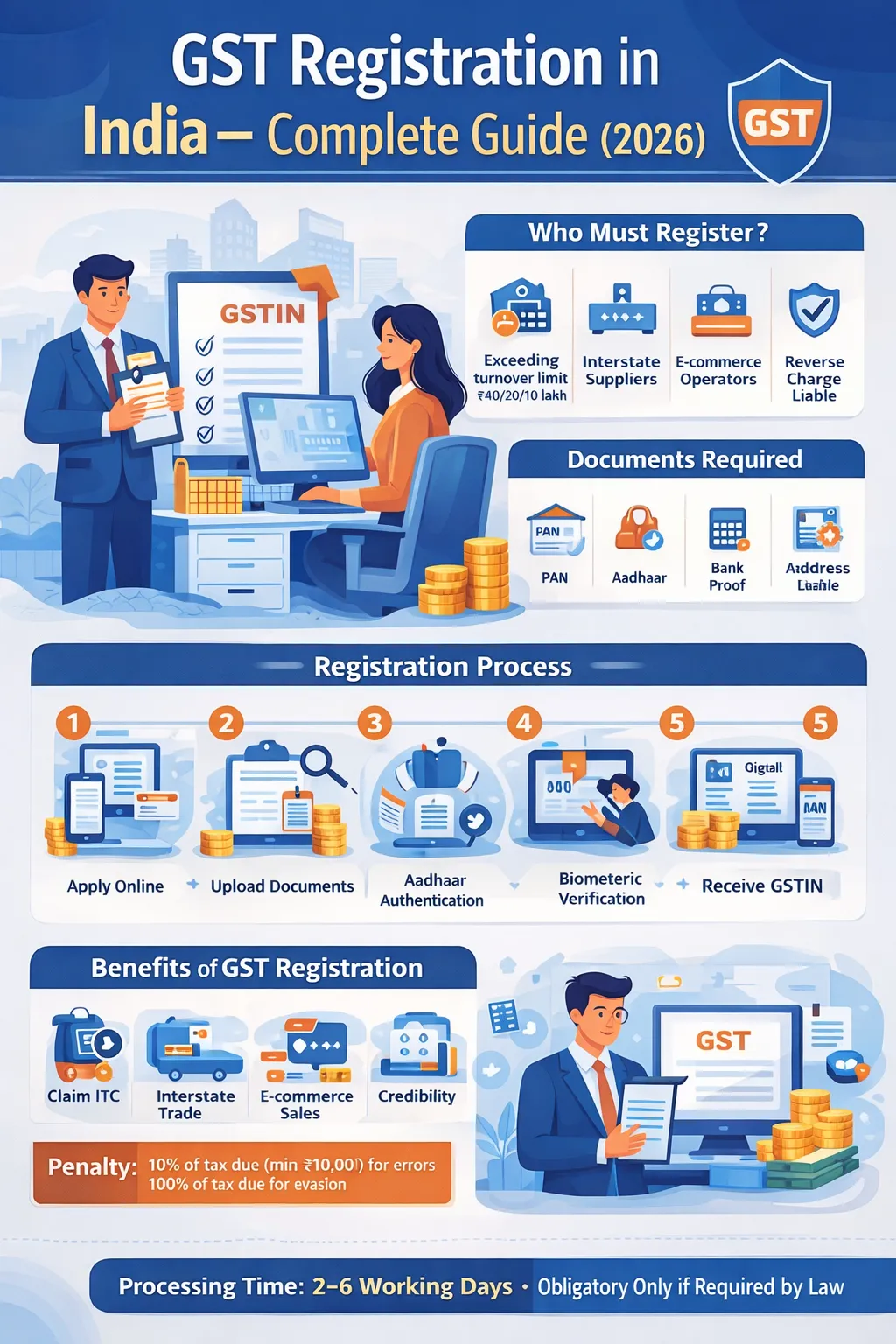
GST registration is a mandatory compliance requirement for eligible businesses and professionals in India. Under the GST regime, entities exceeding prescribed turnover limits or meeting specific criteria must obtain registration to operate legally and avoid penalties. Businesses may also opt for voluntary registration to avail various benefits such as input tax credit and interstate trade access.
Key Takeaways

  • Businesses exceeding prescribed turnover thresholds must register under GST to remain compliant and avoid penalties.
  • As per the GSTN advisory dated 20 November 2025, valid bank account details must be furnished within 30 days of registration or before filing GSTR-1/IFF, whichever is earlier, to prevent suspension.
  • Aadhaar and biometric authentication requirements (GSTN advisory dated 12 February 2025) must be completed within prescribed timelines for ARN generation.
  • Registration applications are verified under strict guidelines issued by the Central Board of Indirect Taxes and Customs (CBIC), including place of business verification as per Central Tax Instruction No. 03/2025-GST dated 17 April 2025.

What is GST Registration?

Under the Goods and Services Tax framework: businesses must register as a normal taxable person if aggregate turnover exceeds:

  • ₹40 lakh (goods – normal category states)
  • ₹20 lakh (services – normal category states)
  • ₹10 lakh (special category states)

Under Section 10 of the CGST Act (Composition Scheme), the threshold limits are:

  • ₹1.5 crore (manufacturers/traders)
  • ₹50 lakh (service providers under composition)

Certain categories of persons are mandatorily required to register irrespective of turnover.

Failure to register when required constitutes an offence under GST law and attracts penalties.

Who Must Obtain GST Registration?

The following persons are required to obtain GST registration:

  • Persons registered under pre-GST laws (Excise, VAT, Service Tax, etc.)
  • Businesses exceeding the prescribed turnover threshold
  • Persons making interstate supplies
  • Casual taxable persons and Non-Resident taxable persons
  • Agents of suppliers and Input Service Distributors (ISD)
  • Persons liable under reverse charge mechanism
  • E-commerce operators (Section 52 of CGST Act)
  • Persons supplying through e-commerce operators (except Section 9(5) notified services)
  • Persons required to pay tax under Section 9(5)
  • Government departments required to deduct TDS under Section 51
  • OIDAR service providers from outside India to unregistered persons in India
  • Suppliers of online money gaming from outside India

Bank Account Requirement (Rule 10A)

As per GSTN advisory dated 20 November 2025:

  • Bank account details must be furnished within 30 days of registration or before filing GSTR-1/IFF (whichever is earlier).
  • Non-compliance may lead to suspension of GST registration.
  • Refund processing and invoice linking may be impacted.

Bank details can be updated via:

Services > Registration > Amendment of Registration (Non-Core Fields)

Benefits of GST Registration

A. For Regular Taxpayers

  • Avail Input Tax Credit (ITC)
  • Conduct interstate trade without restrictions
  • Enhance business credibility

B. For Composition Dealers

  • Simplified compliance
  • Lower tax rates
  • Reduced working capital blockage

C. For Voluntary Registration (Below Threshold)

  • Claim ITC
  • Sell on e-commerce platforms
  • Interstate business freedom
  • Competitive advantage in the market

GST Registration Process

GST registration is applied online through the official Goods and Services Tax Network portal using Form GST REG-01.

Important Compliance Updates:

  1. CBIC Verification Rules (Instruction 03/2025-GST)
    • Mandatory verification of place of business
    • Physical verification where required
  2. Aadhaar & Biometric Authentication (GSTN Advisory – 12 Feb 2025)
    • Selected applicants must complete biometric verification at designated GST Suvidha Kendras (GSK).
    • Non-compliance may delay ARN generation.

Processing time typically ranges from 2–6 working days, subject to verification.

GST Registration Fees

There is no government fee for GST registration on the GST portal.
However, professional service providers may charge a fee for end-to-end assistance and documentation support.

Documents Required for GST Registration

  • PAN of applicant
  • Aadhaar card
  • Incorporation certificate / Business registration proof
  • Identity & address proof of promoters/directors
  • Address proof of principal place of business
  • Bank statement or cancelled cheque
  • Digital Signature (DSC), where applicable
  • Authorization letter / Board resolution for authorised signatory

GSTIN – Goods and Services Tax Identification Number

GSTIN is a 15-digit unique identification number allotted to every registered taxpayer in a state or union territory.

It must be quoted on:

  • Tax invoices
  • GST returns
  • E-way bills
  • Official GST communications

GSTIN ensures authenticity and traceability of transactions under GST.

GST Registration Certificate

Upon approval, a GST Registration Certificate is issued containing:

  • Legal name & trade name
  • GSTIN
  • Principal place of business
  • Additional places of business
  • Authorized signatory details
  • Jurisdiction details (Central & State)

The GST certificate must be prominently displayed at the principal place of business.

Penalty for Non-Registration

Failure to obtain GST registration when required attracts penalties:

  • 10% of tax due (minimum ₹10,000) in case of genuine errors
  • 100% of tax due in case of deliberate tax evasion

Non-registration can also lead to operational disruptions and denial of input tax credit to customers.

Conclusion

GST registration is a critical compliance requirement for businesses operating in India. With updated verification guidelines, Aadhaar authentication requirements, and strict bank account compliance mandates, timely and accurate registration is essential to ensure uninterrupted business operations.

Frequently Asked Questions (FAQs) – GST Registration

1. Who is required to obtain GST registration?

Any business whose aggregate turnover exceeds ₹40 lakh (goods), ₹20 lakh (services), or ₹10 lakh (special category states) must register under the GST law. Certain persons, such as interstate suppliers, e-commerce operators, and those liable under reverse charge, must register irrespective of turnover.


2. Can a business register voluntarily under GST?

Yes. Even if turnover is below the prescribed threshold, businesses can opt for voluntary registration to claim input tax credit (ITC), conduct interstate trade, and improve credibility.


3. How long does GST registration take?

GST registration typically takes 2–6 working days, subject to document verification and compliance with Aadhaar/biometric authentication requirements.


4. Is Aadhaar authentication mandatory for GST registration?

Yes, as per recent GSTN advisories, Aadhaar authentication is required. In certain cases, biometric verification at designated GST Suvidha Kendras (GSK) may also be required for ARN generation.


5. What happens if bank details are not updated after registration?

As per Rule 10A and GSTN advisory dated 20 November 2025, failure to furnish valid bank account details within 30 days of registration (or before filing GSTR-1/IFF) may lead to suspension of GST registration.


6. Is there any government fee for GST registration?

No. There is no government fee for GST registration on the official portal. However, professional service providers may charge consultancy fees.


7. What is GSTIN?

GSTIN (Goods and Services Tax Identification Number) is a 15-digit unique number allotted to registered taxpayers. It must be quoted on invoices, returns, and other GST documents.


8. What is the penalty for not obtaining GST registration?

If a person fails to register when required:

  • Penalty is 10% of tax due (minimum ₹10,000) in case of genuine errors.
  • Penalty is 100% of tax due in case of deliberate tax evasion.

9. Can GST registration be cancelled?

Yes. GST registration can be cancelled voluntarily by the taxpayer or by the department in cases of non-compliance, non-filing of returns, or furnishing incorrect information.


10. Is GST registration state-wise?

Yes. GST registration is required state-wise. If a business operates in multiple states, separate registration must be obtained for each state.

Leave a Reply

Your email address will not be published. Required fields are marked *